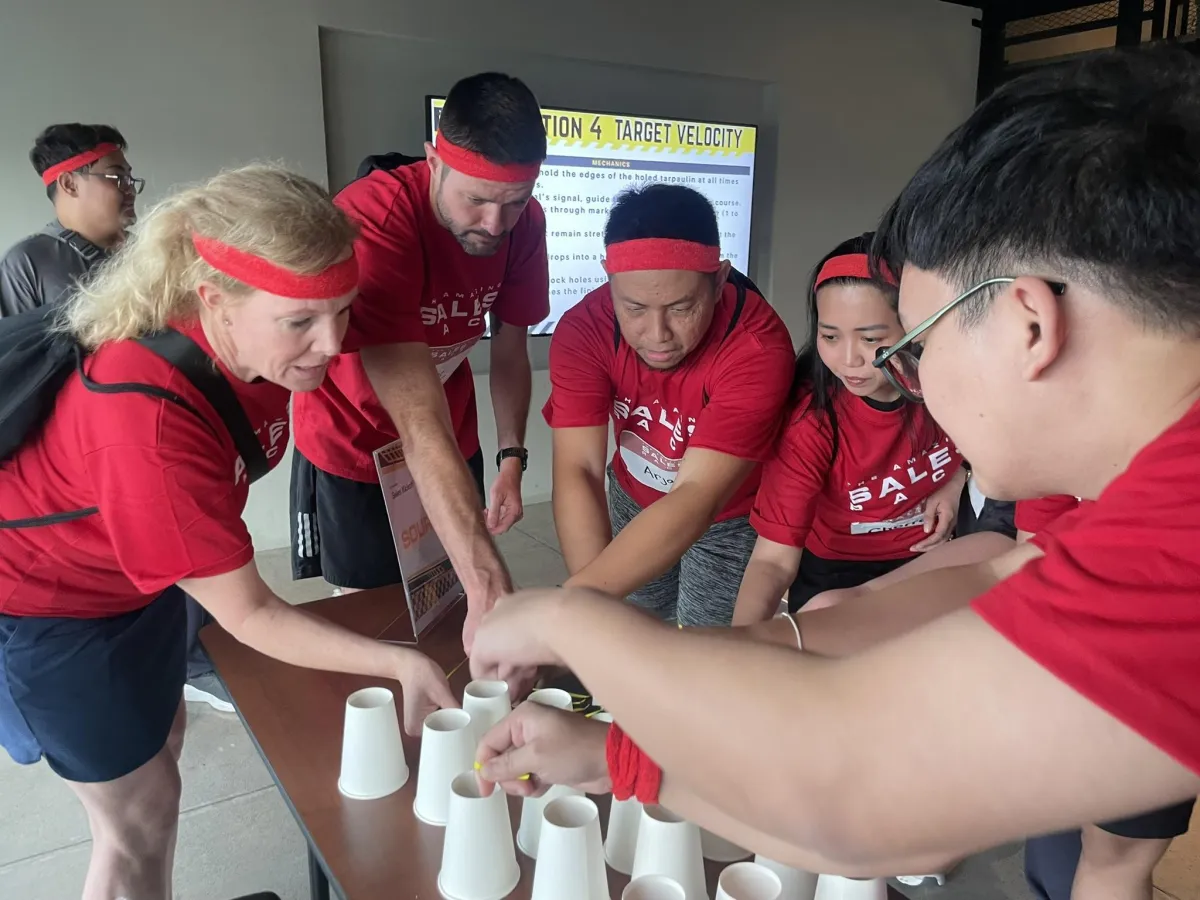
Why Team Building Programs Fail: 7 Common Mistakes and How to Avoid Them
Why Team Building Programs Fail: 7 Common Mistakes and How to Avoid Them
A Dayo Philippines Guide for HR Leaders, Managers, and Corporate Teams
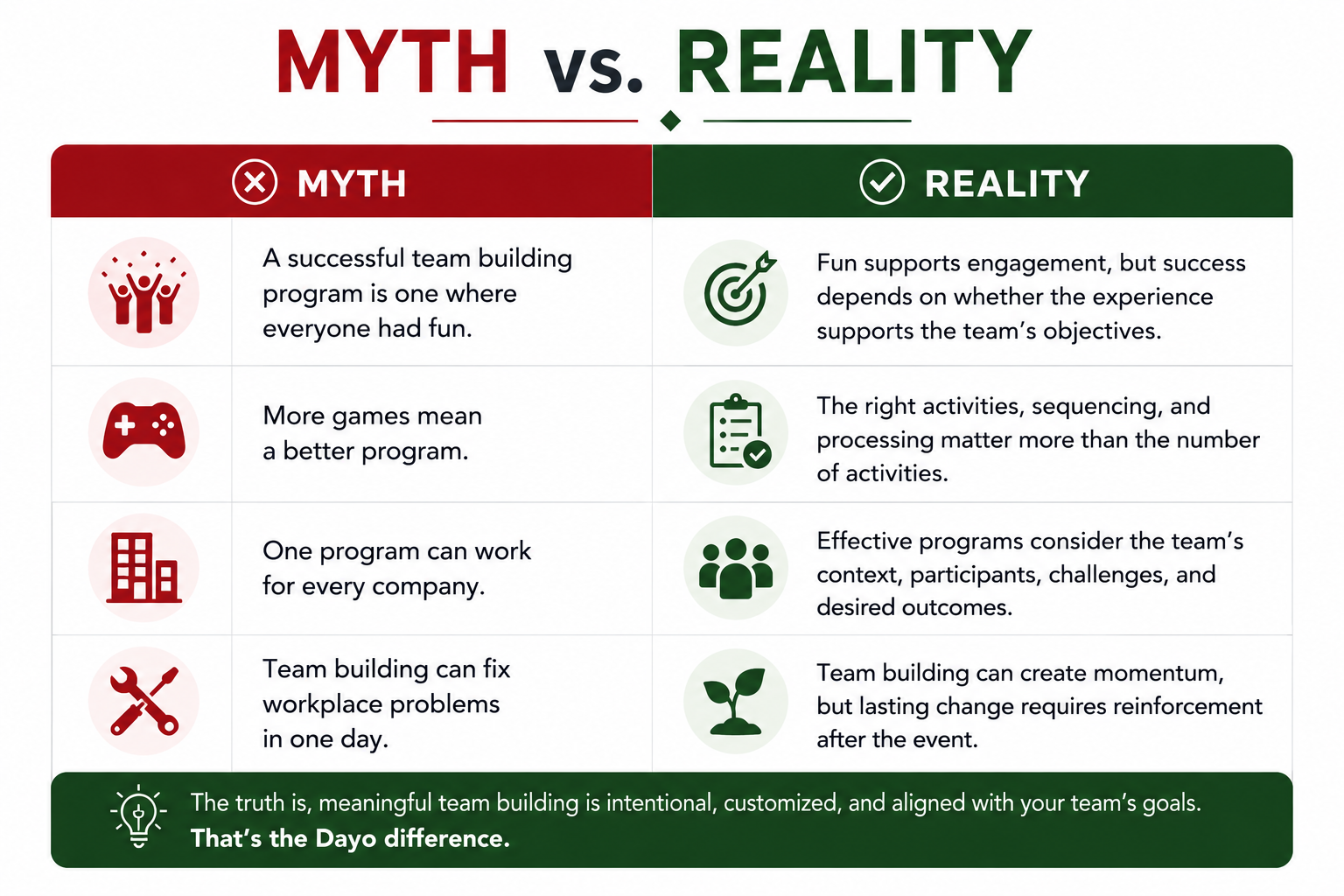
A team building event can look successful on the surface. People laugh. Photos are taken. The program finishes on time. Everyone goes home tired but smiling. Yet a few days later, the same communication gaps, trust issues, silos, and workplace frustrations return.
This is one of the biggest misunderstandings about team building: a fun event is not automatically an effective team building program. Entertainment can create energy, but meaningful team development requires intention, structure, facilitation, and a clear connection between the experience and the workplace.
In the Philippines, companies invest significant time and resources in outings, retreats, and corporate team building activities. Some programs create genuine breakthroughs. Others become memorable company outings but produce little lasting value. The difference is rarely the size of the budget or the number of games. More often, it comes down to how the program was designed and facilitated.
At Dayo Philippines, we believe the strongest programs begin before the first activity starts. They begin with understanding the team: what is happening, what needs to improve, and what the organization wants people to take back to work. Here are seven common reasons team building programs fail, and what HR leaders and organizers can do differently.
1. Starting With Activities Instead of Objectives
One of the most common planning mistakes is asking, “What games should we play?” before asking, “What does this team need?” Activities are tools. They are not the objective.
A communication challenge, a leadership problem, a newly formed team, and a group experiencing low morale should not receive exactly the same program. Even if the same activity is used, the framing, facilitation, observation points, and processing should differ.
When objectives are unclear, the program can become a collection of exciting activities with no meaningful direction. Participants may enjoy themselves, but they may not understand why the experience matters.
A better starting point is to define one to three realistic outcomes. Do you want to strengthen communication? Improve collaboration across departments? Build trust after organizational change? Develop leadership behaviors? Reconnect a team that has been working remotely? Clear objectives help determine the right program design.
The Dayo Perspective: Do not start with the supplier’s activity menu. Start with your team’s reality.
2. Choosing Games Based Only on Entertainment
Energy matters. Laughter matters. Enjoyment matters. A disengaged room is difficult to teach. But when entertainment becomes the only measure of success, team building loses its purpose.
The loudest activity is not always the most meaningful. Sometimes a simple challenge reveals more about communication, leadership, planning, trust, and decision-making than an elaborate obstacle course. What matters is whether the activity creates behavior worth observing and discussing.
A well-designed activity gives participants a problem to solve together. It creates choices, pressure, uncertainty, or constraints that make team habits visible. Who speaks first? Who listens? Who takes over? Who stays quiet? Does the group plan before acting? What happens when the first strategy fails?
Those moments are where learning begins. The activity creates the experience; facilitation helps the team understand it.
3. Using a One-Size-Fits-All Program
No two organizations are exactly alike. A sales team, a leadership group, a manufacturing workforce, and a newly merged department may all need team building, but their realities are different.
A generic program may still be enjoyable, but it often misses the opportunity to address the team’s actual context. Customization does not always mean inventing completely new games. It means designing the experience around the participants, objectives, group size, venue, physical considerations, culture, and desired learning outcomes.
For example, a leadership team may benefit from activities that expose decision-making patterns and delegation. A cross-functional group may need challenges that highlight communication across roles. A newly formed team may need more connection and psychological safety before moving into competitive tasks.
Customization also means knowing when not to force an activity. A program should adapt to the people in the room, not demand that every group fit the same template.
4. Ignoring Group Dynamics and Participant Profiles
A program can be well designed on paper and still fail if it ignores the people who will actually participate.
Age range, physical ability, team history, hierarchy, language, work environment, and group size all affect participation. A highly physical activity may exclude some participants. An overly competitive format may worsen existing tension. A program that assumes everyone is comfortable speaking publicly may unintentionally silence people rather than engage them.
Good facilitators read the room. They observe energy, resistance, confidence, participation, and emerging dynamics. They know when to push, when to adjust, when to ask a question, and when to let the team struggle long enough to learn.
This is especially important in Philippine corporate settings, where hierarchy and respect for authority can influence how openly employees speak. A facilitator must create enough safety for honest participation without forcing disclosure or making people uncomfortable.
5. Confusing Hosting With Facilitation
A great event host and a great team building facilitator can both create energy, manage a crowd, and communicate clearly. But the roles serve different purposes.
An event host primarily manages flow, transitions, audience engagement, announcements, and entertainment. A facilitator manages a learning process. The facilitator observes behavior, asks purposeful questions, connects experiences to workplace realities, and helps participants make meaning from what happened.
Some professionals can do both well. But strong hosting ability does not automatically equal strong facilitation ability. The distinction matters when the organization expects more than a lively program.
If your goal is primarily celebration and entertainment, an excellent host may be exactly what you need. If your goal includes communication, collaboration, leadership, trust, or behavioral reflection, facilitation becomes essential.
For a deeper comparison, see Dayo Philippines’ article, “The Difference Between a Team Building Facilitator and an Event Host.”
6. Skipping Reflection and Processing
This is where many potentially strong programs lose their value. The activity ends, the facilitator announces the winner, and everyone immediately moves to the next game.
Without reflection, participants are left to interpret the experience on their own. Some will see the lesson. Others will remember only the competition.
Processing does not need to become a long lecture after every activity. In fact, effective debriefing is often concise. The facilitator might ask: What happened? What helped your team succeed? What made the task difficult? What did you notice about communication? Where does this show up at work? What would you do differently next time?
The goal is not to tell participants what they learned. The goal is to help them discover patterns themselves. When people articulate the insight in their own words, the learning becomes more relevant and memorable.
A facilitator should also avoid forcing every activity into a dramatic life lesson. Good processing is grounded in what actually happened. It respects the intelligence of the participants and connects the experience to work only where the connection is meaningful.
7. Treating Team Building as a One-Day Cure
Team building can create momentum, but it cannot repair every organizational problem in a few hours.
A team with unclear roles, poor management practices, unresolved conflict, or broken systems may benefit from a well-designed program, but the event cannot replace ongoing leadership and organizational action. Expecting one day of activities to permanently solve deep workplace issues creates unrealistic expectations for both participants and organizers.
The strongest approach is to treat team building as part of a larger process. The event can create shared language, surface patterns, strengthen relationships, and introduce new behaviors. What happens afterward determines whether those insights continue.
Managers can reinforce key commitments during meetings. Teams can revisit agreements. HR can connect learning points to leadership development, employee engagement, or culture initiatives. Even a simple follow-up conversation can extend the value of the experience.
The key idea: Team building is an intervention, not a miracle cure.
What Effective Team Building Looks Like
An effective program does not need to be overly serious. It can be energetic, competitive, funny, and memorable. The difference is that the fun has direction.
The strongest programs usually share several characteristics: clear objectives, thoughtful customization, activities appropriate for the participants, professional facilitation, meaningful reflection, and a connection to what happens after the event.
Success may look different for every organization. For one team, it may be improved communication between departments. For another, it may be leaders becoming more aware of how they make decisions. For a newly formed group, success may simply mean building enough trust to work together more openly.
That is why the question should not be, “Was the event fun?” The better question is, “Did the experience help move the team in the direction we intended?”
Questions HR Should Ask Before Booking a Team Building Program
What specific outcome do we want from this program?
EWhat is currently happening within the team that the facilitator should understand?
How will the program be customized for our participants and objectives?
Who will facilitate the program, and what is their approach to processing?
How will activities connect to workplace behavior without becoming forced or generic?
Are the activities appropriate for the group’s age range, physical ability, and culture?
What should managers or HR reinforce after the event?
The Dayo Perspective
At Dayo Philippines, we do not believe that team building should feel like a classroom disguised as an outing. We also do not believe that entertainment alone is enough.
The best programs create a balance. People should participate, laugh, compete, collaborate, and enjoy the experience. At the same time, the design should give teams opportunities to notice how they communicate, lead, adapt, solve problems, and respond to one another.
Our role is not to manufacture a dramatic breakthrough in every activity. It is to create the conditions for meaningful experiences, observe what emerges, and help teams connect those moments to their own reality.
That is also why choosing the right facilitator matters. Experience, customization, group management, safety, and the ability to process learning all influence whether a program becomes simply a memorable event or a meaningful team intervention.
If you are currently evaluating providers, you may also read our guide, “How to Choose a Team Building Facilitator in the Philippines.”
HR Takeaways:
Start with the objective, not the activity list.
Choose activities because they support the program, not simply because they look exciting
Avoid one-size-fits-all programs when your team has specific needs.
Consider participant profiles, group dynamics, hierarchy, and physical accessibility.
Know the difference between hosting and facilitation.
Make room for reflection and processing.
Plan how key insights will be reinforced after the event.
Frequently Asked Questions
Why do some team building activities fail?
Activities often fail when they are selected without considering the team’s objectives, participant profile, group dynamics, or the role of facilitation. An activity can be enjoyable and still have little relevance to the organization.
Does team building need to be serious to be effective?
No. Effective team building can be highly energetic and enjoyable. Fun supports engagement. The key is to combine that energy with intentional design, appropriate challenges, and meaningful reflection.
How many activities should a team building program have?
There is no ideal number. The right number depends on the duration, objectives, group size, venue, and complexity of the activities. A smaller number of well-designed and well-processed activities can be more valuable than a packed schedule.
Can one team building program solve workplace conflict?
A program can help improve communication, create shared experiences, and surface useful insights, but serious or long-standing conflict may require additional interventions. Team building should not be treated as a substitute for management action, mediation, coaching, or organizational change when those are needed.
How do we choose the right team building provider?
Look beyond the activity list. Ask how the provider understands your objectives, customizes the program, manages safety, facilitates different participant profiles, and processes learning. Relevant experience and the ability to explain the purpose behind the program are important indicators.
Planning a Team Building Program That Creates More Than a Good Memory?
A successful team building program should be enjoyable, but it should also be intentional. The right design can help teams communicate better, strengthen collaboration, develop greater awareness, and create shared experiences that continue beyond the event day.
At Dayo Philippines, we design customized team building programs around your organization’s objectives, participants, and desired outcomes. From program design and facilitation to venues and event logistics, we help companies create experiences that are engaging, purposeful, and built for their team.
Let’s design a program that works for your team.